
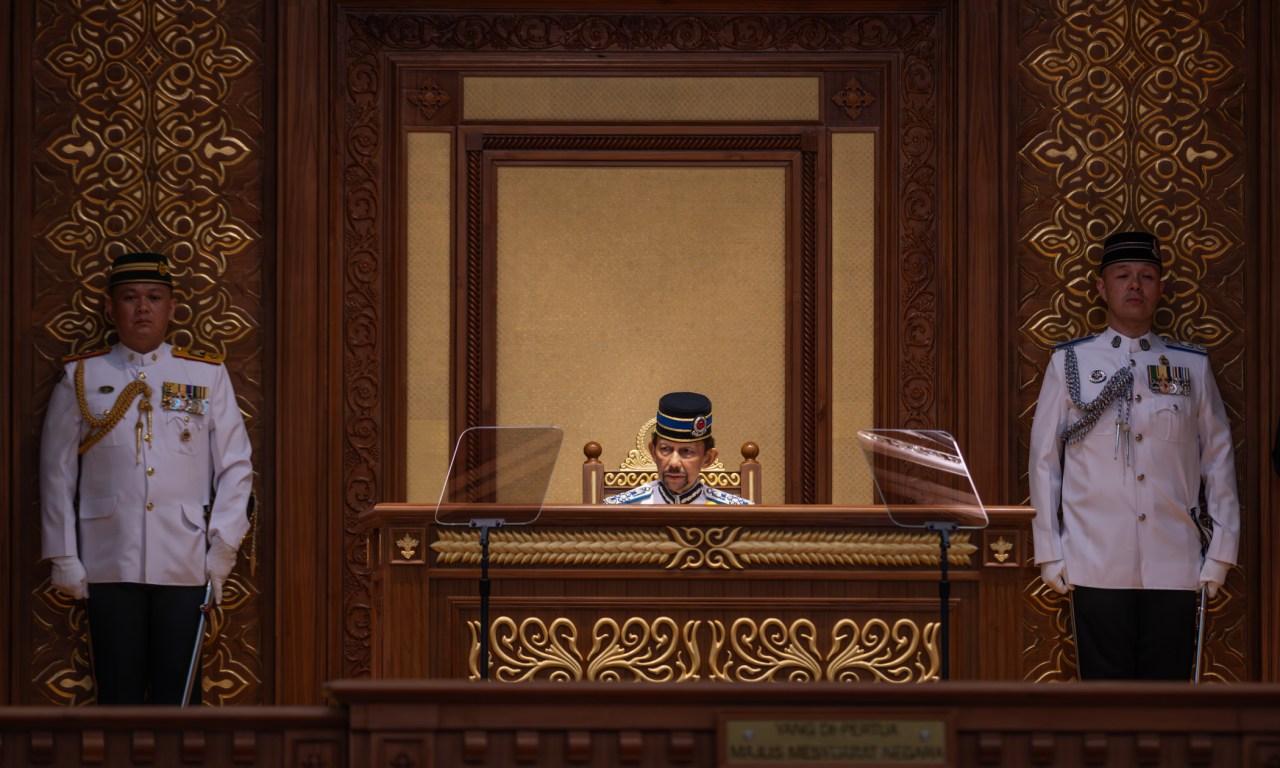
BANDAR SERI BEGAWAN – His Majesty Sultan Haji Hassanal Bolkiah opened the 21st session of the Legislative Council, Brunei’s parliamentary body, on Wednesday, announcing some major shifts in government policy.
In his customary address to the chamber, the monarch touched on the economy, healthcare for stateless permanent residents, and increasing the number of LegCo sessions annually.
Here are the key takeaways from his titah.
LegCo will now meet twice a year
The sultan granted approval for two sessions of parliament a year, beginning in 2025.
Since the Legislative Council was revived in 2004, it has typically convened once a year in either February or March, before the end of the financial year. During the 2-3 weeks that parliament is in session, the government budget is tabled for discussion.
“The role of the members of the Legislative Council is to deliberate on key matters, including providing feedback on every government policy to ensure that it truly yields a positive impact on the well-being of the people,” His Majesty said.
“Therefore, every proposal and idea presented in this chamber is valuable and should be thoroughly examined.”
The monarch added that a code of ethics should be formulated for LegCo members, so that they can serve “more effectively and with greater integrity”.
“These changes will strengthen the effectiveness of council meetings through more structured, focused, and continuous discussions,” he said.

Stateless permanent residents to see improved medical benefits
The sultan announced that permanent residents of Brunei who do not hold citizenship elsewhere (stateless individuals) will be able to access healthcare services “similar to those provided to citizens”.
The government provides universal healthcare for all citizens, who only pay a registration fee of BND$1 for each hospital or clinic visit, while treatment and medication is free.
The monarch has granted approval for the Ministry of Health to revise the existing service charge for stateless permanent residents, who are currently entitled to free medication, but must pay a BND$3 registration fee and bear the cost of any surgery.
His Majesty did not specify in his titah what changes would be made, but when contacted by The Scoop, the health ministry said further details would be announced soon.
While it is hard to find reliable data on the number of stateless people in Brunei, at the end of 2022, the Office of the United Nations High Commissioner for Refugees, citing Brunei government data, reported that there were 20,863 stateless persons in the sultanate.
Downstream activities continue to drive economic growth
The growth of the downstream oil and gas sector over the past five years — spurred by Hengyi’s petrochemical plant on Pulau Muara Besar — has seen downstream activity contribute BND$1.24 billion to GDP in 2023, up from a modest BND$136 million in 2017.
“It is clear that the establishment of the petrochemical industry, which produces petroleum, methanol, and urea, has been a key driver of this growth,” His Majesty said.
The sultan said diversification efforts have begun to show encouraging results, citing the export of new products such as urea fertilisier to markets including Chile, Mozambique, Colombia, Peru, and Mexico.
“This will position the country as a hub for chemical and manufacturing industries, while also exploring energy transition initiatives toward a more sustainable environment,” the sultan added.