

BANDAR SERI BEGAWAN – Artificial intelligence will be central to Brunei’s next Digital Economy Master Plan, government officials said Tuesday, with the current five-year masterplan wrapping up in 2025.
“Brunei is in the process of preparing a Data and AI Strategy as part of a larger initiative — a national roadmap that defines our long-term approach to artificial intelligence,” said Hj Hairul Mohd Daud Hj Abdul Karim, acting permanent secretary at the Ministry of Transport and Infocommunications.
The acting permanent secretary delivered the keynote speech at a policy seminar on artificial intelligence, organised by the EU-Brunei Darussalam Partnership Facility.
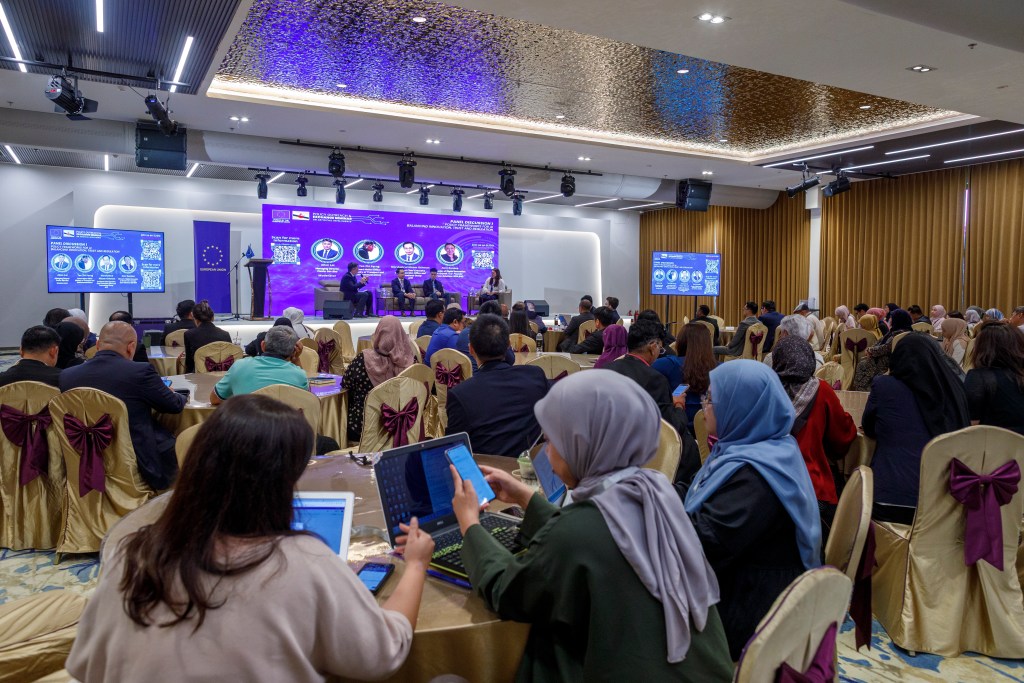
Hj Hairul stated that AI will be a key enabler for enhancing public services and expanding access to healthcare and education.
“However, with these opportunities come new policy responsibilities. For small, highly connected nations like ours, it is critical that we get the foundations right — building systems that are safe, ethical, and inclusive.”
He said central to this trust is the launch of Brunei’s Guidelines on AI Governance and Ethics, developed by the Authority for Info-communications Technology Industry of Brunei Darussalam (AITI). These guidelines set out national principles for responsible AI adoption — which emphasise transparency, human oversight, risk management, and “alignment with national values”.

How should AI be regulated?
Brunei and the EU, while sharing common concerns in AI policy — like ethics, data privacy, cybersecurity, and digital inclusion — diverge on the extent of government oversight needed.
In 2024, the European Union introduced the Artificial Intelligence Act, the world’s first comprehensive legal framework specifically designed to regulate artificial intelligence.
Its primary goal is to ensure that AI systems developed and used within the EU are safe, transparent and ethical, said Dr Sander Happaerts, green and digital counsellor at the EU Delegation to Indonesia and Brunei Darussalam.
“It takes a risk-based approach, and it intervenes where it’s necessary, and it doesn’t intervene where it’s not necessary.
“We believe that such regulation is essential because accountability and guardrails are crucial to foster the trust of citizens and consumers and to enable a broad uptake of artificial intelligence.”

While the EU has enacted legislation, Brunei prefers a more “flexible and innovation-friendly approach” to AI, explained Norshahrul Nizam Othman, AITI’s assistant chief executive. This position aligns with ASEAN’s regional stance, which favours voluntary guidelines over formal legislation.
“This does not mean we are not serious about governing AI,” he added. “We recognise the potential dangers of AI, but at this stage, the current approach to governance [leans towards] guidance rather than regulation.”