
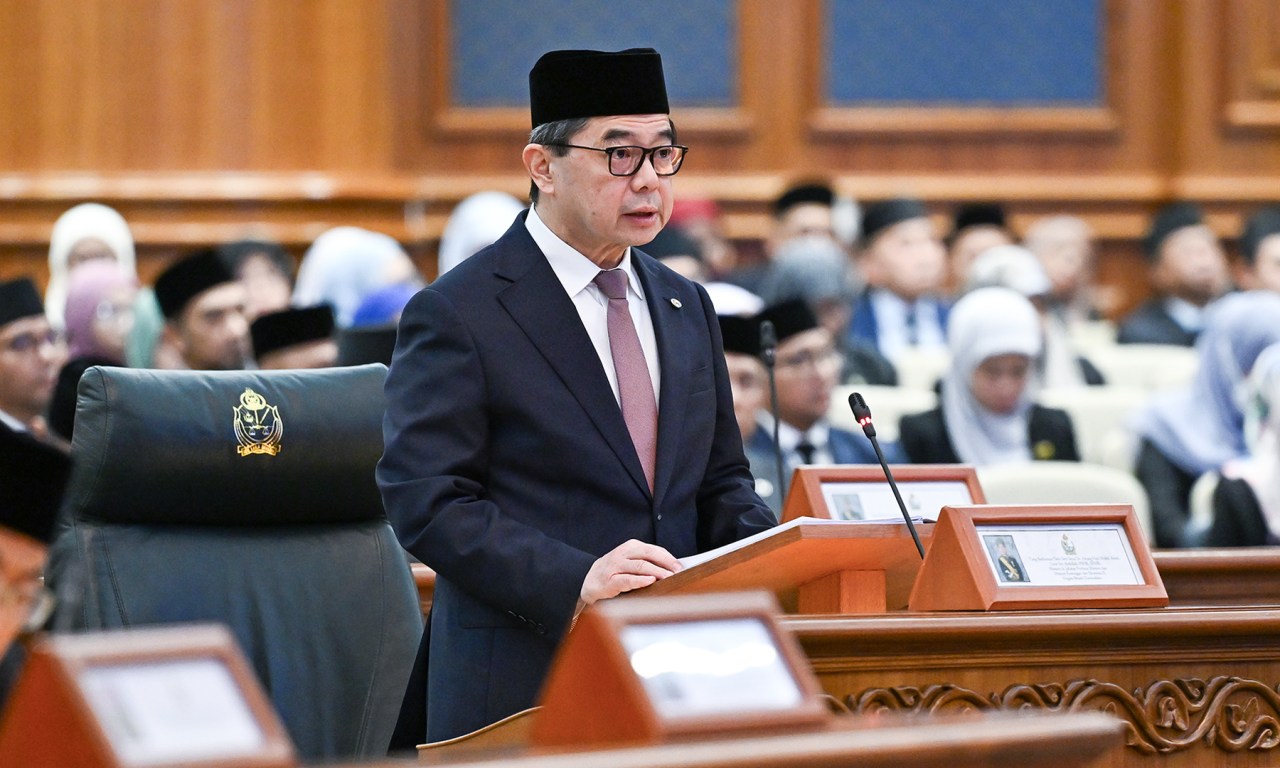
BANDAR SERI BEGAWAN – The government has tabled a B$6.3 billion supply bill for the 2026/27 financial year, seeking to balance fiscal prudence with Brunei’s long-term development needs.
Addressing the Legislative Council on Saturday, the Second Minister of Finance and Economy, Dato Dr Hj Mohd Amin Liew Abdullah, confirmed that the government expects to carry its fiscal deficit into the upcoming year. While the deficit was originally forecast to reach B$3.1 billion by the end of FY 2025/26, the government has yet to release updated figures.
With war in the Persian Gulf disrupting global energy markets, Dato Dr Hj Mohd Amin stressed that maintaining macroeconomic stability is now critical. “Global economic uncertainties—influenced by geopolitical tensions, shifting trade structures, modest global growth prospects and climate change—require the government to act strategically,” he said.
He warned that an over-reliance on oil and gas is unsustainable, noting that while Brunei remains an open economy, that very openness leaves it “vulnerable to external factors such as trade tensions and import cost pressures”.
Tracking economic growth
Reviewing the nation’s economic performance, Dato Dr Hj Mohd Amin reported that Brunei’s economy grew by 0.7% in 2025. This was driven by a 3.1% uptick in the oil and gas sector, which offset a 1.5% decline in the non-oil and gas sector.
Despite the moderate growth, he urged a long-term perspective, emphasising that from 2015 to 2025 GDP grew by an average of 0.6% annually, while the non-oil sector grew at a more robust 2.7% during the same period.
By 2025, non-oil goods accounted for 61% of total exports and 54% of GDP, driven by the manufacture of chemical and petroleum-derived products. “This indicates that in the long-term the economy is showing positive gradual change,” the minister said.
Estimates for GDP growth in 2026 range from 1.5% to 2.4%, according to estimates from different financial institutions.
The private sector has also seen significant expansion: business revenue grew from B$25.9 billion in 2015 to B$35.4 billion in 2024, while the private sector’s share of the workforce rose from 53% to 70% over the same decade.
Dato Dr Hj Mohd Amin said it marked a structural shift in the economy that is increasingly driven by the private sector rather than the public sector. However, he noted that challenges remain, citing a skills mismatch between the workforce and industry requirements, and artificial intelligence transforming the nature of work.
To sustain economic momentum, the government aims to drive future growth by focusing investment on key sectors, including downstream oil and gas, food, services, tourism, and ICT.
Roadmap to Vision 2035
With less than ten years remaining to reach long-term objectives, this year’s budget is themed “Together Achieving Vision 2035”, focusing on accelerating the transition toward a sustainable and diversified economy.
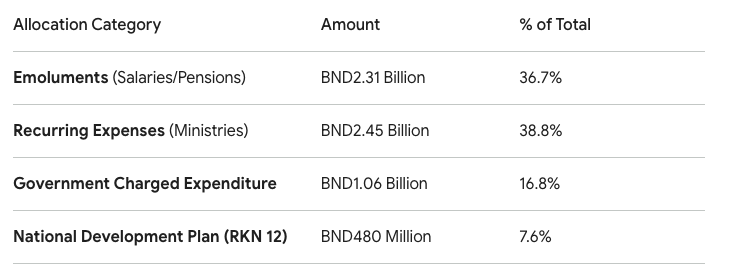
The proposed B$6.3 billion supply bill allocates B$2.31 billion (36.7%) to emoluments such as salaries and pensions, while B$2.45 billion (38.8%) is earmarked for the recurring expenses of government ministries.
Additionally, B$480 million is allocated for projects under the 12th National Development Plan (RKN 12), with the remaining B$1.06 billion falling under the government’s charged expenditure.
“Faced with today’s fiscal realities and global challenges, we can no longer view the budget merely as a list of expenditures,” Dato Dr Hj Mohd Amin concluded. He stated that the deficit would be managed through prudent expenditure control and efforts to bolster non-oil and gas revenue.