

BANDAR SERI BEGAWAN – The government has tabled a supply bill of $6.25 billion for the 2024/2025 financial year, with spending up 5.5% as the country invests more in digitalisation and public infrastructure.
Speaking at the Legislative Council on Thursday, the Second Minister of Finance and Economy Dato Dr Hj Mohd Amin Liew Abdullah said government earnings had almost halved from $6.35 billion in FY 2022/23 to $3.22 billion in FY 2023/24, due to lower energy prices and disruptions to domestic oil and gas production.
An estimated 75% of government revenue is derived from oil and gas, while the industry makes up roughly half of the sultanate’s GDP.
The minister said the government is currently sitting on a budget deficit of $2.7 billion (as of Feb 29) with the financial year closing on March 31.
That deficit is set to widen to $2.99 billion in FY 2024/25, with government revenue projected at $3.6 billion in the next year.
To finance the budget shortfall, the government continues to draw down on its fiscal reserves, which are estimated at US$73 billion, according to the Sovereign Wealth Fund Institute.
“In the years ahead, we will face more challenges, such as the rapid transformation of technology, increasing cyber threats, the threat of climate change and environmental pollution, social and demographic changes, geopolitical instability, the evolution in education and skill development, health challenges, and other challenges beyond our control,” Dato Dr Hj Mohd Amin said.
“As as a small country with an open economy, we cannot escape from these external factors… Despite the challenges, we should take the opportunity and make it a stepping stone for transformation.”
Strategic investment in downstream sector
Brunei’s post-pandemic recovery has been weaker than expected. The economy grew just 1.4% in 2023 — after contracting the previous two years — with the level of output lower than a decade ago.
Crude oil production has fallen from a peak of 220,000 barrels/day in 2006 to less than 90,000 barrels/day in 2023, while natural gas production follows a similar trajectory.
Brunei is shifting focus from upstream to downstream oil and gas, with Hengyi’s refinery and petrochemical plant being a key driver of growth since operations began in 2019.
In 2022, the project — a multi-billion joint venture between the Brunei government and the Chinese conglomerate — contributed to 55% of Brunei’s exports and 9.4% of its GDP. However, downstream activity declined significantly in the first half of 2023 due to scheduled maintenance of the refinery.
The second phase of the project, set to go online in 2029, is expected to boost refining capacity even further and generate derivative products needed in the production of textiles, plastics and rubber.
Dato Dr Hj Mohd Amin said the government has made “strategic investments” in the downstream sector, referencing several new projects including Brunei Fertiliser Industries, which recorded $356 million in urea exports last year; and construction of two new plants to manufacture acetic acid and aniline, which are used in the production of plastics and rubber.
Accelerating growth of non-oil and gas sector
The minister also stressed the need for Brunei to accelerate growth of non-oil and gas industries such as food processing, business services, ICT and tourism.
He mentioned the country’s first shipment of chicken eggs to Singapore last year as a significant milestone (exports totalled $5 million in 2023), following the success of aquaculture exports in recent years.
Overall, the non-oil and gas sector grew 4.5% in 2023, attributed to growth in sub-sectors such as air transport, finance and construction.
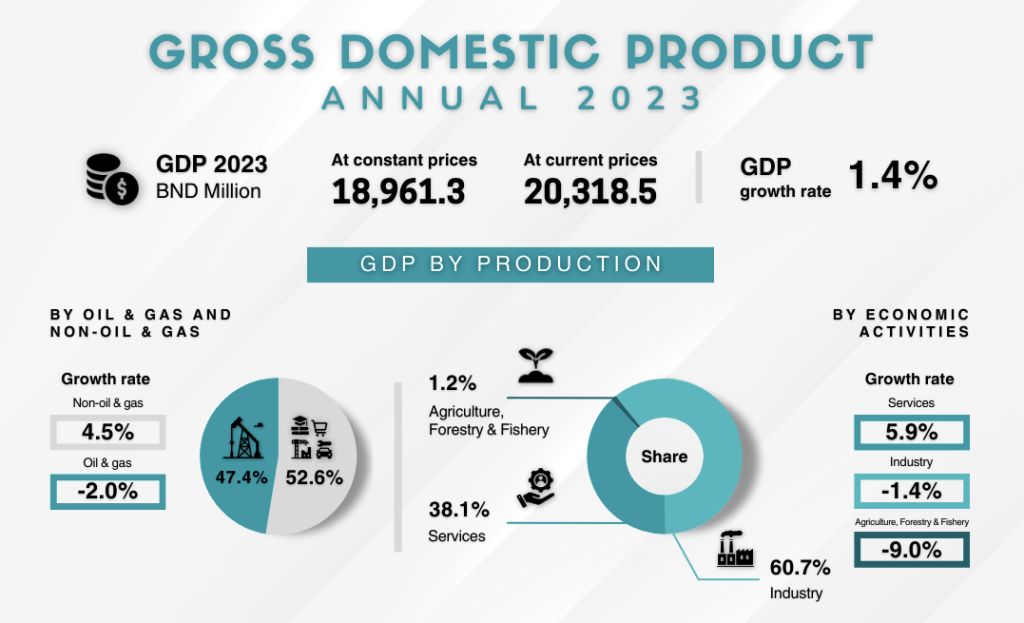
The Ministry of Finance and Economy is projecting that Brunei’s GDP will grow between 3.3% to 4% in 2024, anticipating an increase in oil and gas production, while the downstream sector will be boosted by more petrochemical manufacturing.
Reports from the IMF, ASEAN Plus 3 Macroeconomic Research Office (AMRO) and the Asian Development Bank (ADB) also see an upswing for Brunei this year, forecasting growth of 3.5%, 2.4%, and 2.5% respectively.
However, Dato Dr Hj Mohd Amin said growth projections may be tempered by a number of factors: global inflation, fluctuating energy prices, and ongoing geopolitical pressures that could cause supply chain disruptions.
Brent crude is likely to stay near US$80/barrel in 2024 due to conflict in the Middle East and delivery issues through the Red Sea, but weak global growth and a predicted increase in oil inventories is likely to cap demand by 2025.
‘Building a Prosperous Future Together’
The government budget will maintain the theme of “Building a Prosperous Future Together” for the next two years.
From a proposed budget of $6.25 billion, some $2.29 billion will go towards emoluments, meaning salaries, allowances and pension contributions for government employees.
A total $2.4 billion will be earmarked for recurring expenses, while $500 million will be carved out for projects under the twelfth National Development Plan (RKN 12), which has a five-year allocation of $4 billion.
The balance of $1.06 billion will go towards the government’s charged expenditure.
The 2024/25 supply bill will focus on three focus areas: improving public welfare and productivity; cultivating a sustainable and diversified economy; and development of dynamic and visionary human capital.
Here are some of the key allocations highlighted in the budget readout:
Focus 1: Improving public welfare and productivity
• $400 million to upgrade and strengthen electricity supply networks, including construction of the second phase of Bukit Panggal Combined Cycle Power Plant (allocation under RKN 12).
• $277 million for public housing in Lugu, Rimba, Salambigar, Lumut and Tanah Jambu (allocation under RKN 12).
• $261 million to improve clean water supply; upgrading of water infrastructure (allocation under RKN 12).
• $19.4 million to digitalise judicial case management and upgrade technology in Brunei’s courts (allocation under RKN 12).
• $29.4 million for database and asset management at the Ministry of Development, including digitalising housing applications and payments (allocation under RKN 12).
• $21.2 million for the National Education Management System, which will digitalise data and records for schools, students and teaching staff, and also include a student admissions management system (allocation under RKN 12).
• $256.5 million to develop medical and health infrastructure, including construction of a new block at RIPAS Hospital, upgrading of Suri Seri Begawan Hospital, and building of a new buildings for laboratory services (allocation under RKN 12).
• $62.5 million for a comprehensive upgrade of Bru-HIMS, which will standardise patient records and data management, and introduce new ‘intelligent’ systems that can create customised care plans and treatment recommendations.
• $89 million for purchase of medicines.
• $150 million for external patient treatment at JPMC, Brunei Cancer Centre, and Brunei Neuroscience, Stroke & Rehabilitation Centre.
• $37 million for prevention and treatment of infectious disease outbreaks, and assistance to affected groups.
• $50 for green building initiatives (allocation under RKN 12).
• $17.6 million for forest conservation and replanting.
• $1 million for National Adaptation Plan for Climate Change (allocation under RKN 12).
• $62.5 million for flood prevention (allocation under RKN 12); a further $25 million for disaster management.
Focus 2: Cultivating a sustainable and diversified economy
• $36 million to support digital transformation in government; including upgrade of GOV.BN and creation of Integrated Statistical Data System (allocation under RKN 12).
• $144.7 million for IT procurement and software licensing.
• $15.7 million for Smart Transport System to address public transport issues (allocation under RKN 12).
• $80 million for infrastructure in agricultural areas; $68.3 million to improve irrigation in agricultural areas (allocation under RKN 12).
• $9 million for rice repurchase scheme and purchase of hybrid seeds.
• $17.5 million to increase vegetable production (allocation under RKN 12).
• $18 million for Livestock Industry Development Plan; $39 million to mitigate and control pollution from livestock industry (allocation under RKN 12).
• $18.5 million to develop sites for aquaculture (allocation under RKN 12).
• $36.4 million for tourism development, including improving basic facilities and infrastructure at tourist attractions (allocation under RKN 12).
• $60 million to overhaul airport runways, improve aerodrome infrastructure (allocation under RKN 12).
Focus 3: Development of dynamic and visionary human capital
• $24.1 million upgrade network infrastructure in schools to support digital learning tools.
• $473 million to upgrade and build educational facilities, including new campuses for UNISSA and Politeknik Brunei (allocation under RKN 12).
• $37.3 million for scholarships under MOE and MORA.
• $1.5 million for Miftaahun Najaah Scheme to support underprivileged students.
• $24 million under Manpower and Planning Council for several programmes including i-Ready, TVET Scheme, Skillsplus, SPIN in Accountancy and Tradeskills.
• $61 million under RKN 12 to build the Creative, Cultural, Industries Hub (CCI Hub) and Community Library, as part of efforts to empower creatives and strengthen the country’s arts and culture infrastructure. The same allocation will also fund research under higher education institutions and the Council for Research and Advancement in Technology and Science.